
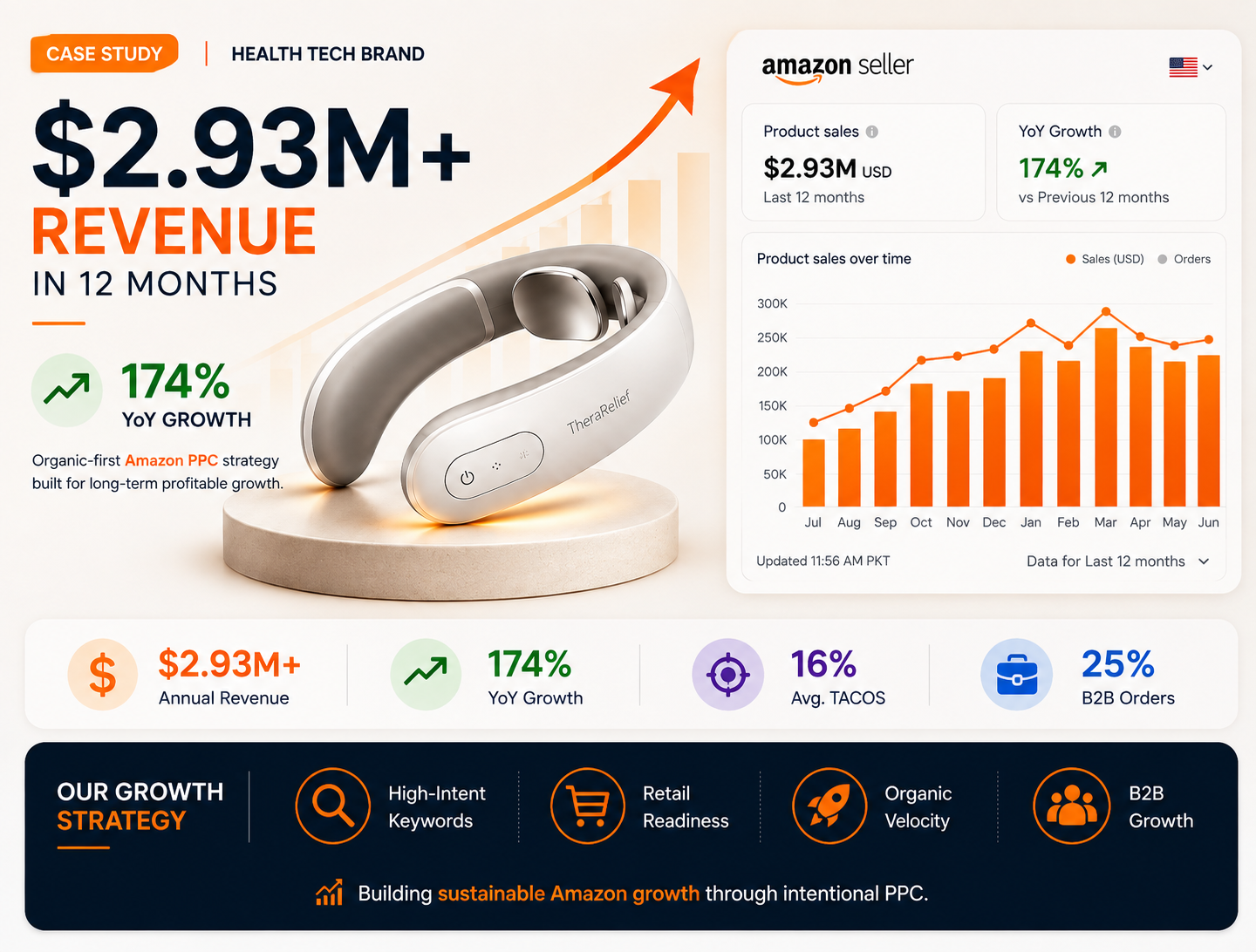
From $0 to $4M in Under 30 Months: An Amazon PPC Growth Case Study
- CHALLENGE
- $6–$8 CPCs and cheaper competitors made profitable scaling challenging.
- STRATEGY
- Built retail readiness, owned high-intent search, then expanded category-wide.
- OUTCOME
- $0 → $4M in under 30 months from one parent listing.
How we scaled a single-listing health & Wellness brand from $0 to $4M in under 30 months using intent-led Amazon PPC, organic keyword ranking, retail readiness, and conversion optimization, while keeping TACOS at 15%.
From $0 to $4M in Under 30 Months: An Amazon PPC Growth Case Study
How we scaled a health-tech brand from launch to $260K+ in average monthly revenue—from a single parent listing.
$6–$8 Top-of-Search CPCs. Cheaper competitors. A $34.99 starting price. One core USP.
When this health-tech product launched on Amazon in March 2024, competing for the biggest keywords wasn't our first priority.
The category was already crowded. Established competitors were selling cheaper alternatives, Top-of-Search CPCs could reach $6–$8, and some B2B placements climbed as high as $10–$15 per click.
Trying to dominate the entire category from day one would have meant buying some of the most expensive traffic before the product had built the foundation to compete.
So we started somewhere smaller—but much more valuable.
We identified the search intent where the product had the strongest reason to win, built the retail experience around it, and expanded only after establishing that position.
The result?
$0 → $4M in under 30 months, from one parent listing, while keeping TACOS around 12-17% throughout the growth journey.
The Challenge: How Do You Scale When Amazon CPCs Reach $6–$8?
The product entered a highly competitive market at $34.99, surrounded by lower-priced alternatives.
There was also significant work to do before scaling traffic. Retail readiness, conversion optimization, positioning, SEO and creatives all needed to work together.
And traffic itself wasn't cheap.
For competitive searches, Top-of-Search CPCs reached $6–$8. Certain B2B placements could reach $10–$15 CPCs.
Going after the category's biggest keywords immediately would have created a simple problem:
We would be paying premium prices for traffic before establishing a strong reason for shoppers or Amazon, to choose this product.
Fortunately, the product had one clear advantage.
A strong USP tied to a specific purchase intent.
That became our entry point.
The Strategy: Win the Intent Before Trying to Win the Category
Most Amazon PPC strategies begin with keyword volume.
We started with customer intent.
Instead of asking:
“Which keywords have the highest search volume?”
we asked:
“For which searches does this product have the strongest reason to win?”
Some of those keywords had only a few hundred monthly searches.
That didn't concern us.
They represented shoppers looking for something closely aligned with the product's core USP and therefore gave us a much stronger starting point than broad category traffic.
Our roadmap became simple:
Retail Readiness → Own High-Intent Search → Build Organic Rankings → Expand Category-Wide
1. Build Retail Readiness Around One Clear USP
Before aggressively scaling Amazon PPC, we strengthened the foundation.
The product's positioning, listing content, SEO, creatives and advertising message were aligned around the same core customer need.
The goal was consistency.
A shopper moving from search results to an ad and then onto the product detail page should immediately understand:
“This product is relevant to exactly what I'm looking for.”
We weren't trying to communicate every possible benefit.
We wanted to make the product's strongest reason to buy unmistakable.
That alignment gave us a stronger conversion foundation before increasing advertising pressure.
2. Structure Amazon PPC Around Search Intent
We didn't build campaigns around hundreds of disconnected keywords.
Related searches were grouped around root keywords and purchasing intent.
That meant PPC, SEO, creatives and listing positioning could all reinforce the same search theme.
Instead of thinking:
Keyword → Ad → Order
we thought:
Purchase Intent → Keyword Cluster → PPC → Sales Velocity → Organic Ranking
This changed the role of advertising.
Amazon PPC wasn't simply being used to buy the next order.
It was being used strategically to help establish the product around the searches where it had the strongest competitive advantage.
3. Own the High-Intent Keywords First
This became the first major growth phase.
We concentrated advertising and optimization around our highest-intent keyword cluster even though many of those keywords had relatively modest search volume.
Why?
Because relevance mattered more than raw volume at this stage.
As conversion history and sales velocity strengthened, organic positions improved.
Eventually, the product reached #1 organic positions across approximately 90% of the targeted high-intent keyword set.
That created something more valuable than another paid click:
organic visibility.
And as that foundation strengthened, the business scaled to approximately:
$150K/Month
But reaching $150K/month created a new question.
Where does the next phase of growth come from?
4. From Intent Ownership to Category Expansion
At $150K/month, continuing to dominate the same narrow keyword set wouldn't be enough.
We needed a larger addressable market.
So the strategy evolved.
Instead of only defending the high-intent searches we already owned, we began moving into broader, higher-volume category keywords.
Those searches were more competitive and more expensive—but now we were entering them from a completely different position.
We had:
Proven Positioning → Sales History → Conversion Data → Organic Rankings → Customer Trust
We were no longer asking an unproven listing to compete against established category leaders.
We had built the foundation first.
The progression became:
Own the Intent → Expand the Intent → Compete for the Category
That expansion helped move the business beyond $150K/month toward approximately:
$260K+ Average Monthly Revenue
5. We Didn't Optimize Amazon PPC for ACOS Alone
When Top-of-Search clicks can cost $6–$8, forcing every campaign toward the same low ACOS can create another problem:
You may cut the exact traffic supporting your most important growth opportunities.
So we didn't evaluate every campaign in isolation.
Different campaigns had different jobs.
Some captured high-intent demand efficiently.
Some supported strategically important keyword positions.
Some explored new search opportunities.
Others captured incremental traffic through lower bids.
The principle was:
Invest where growth justifies it. Protect efficiency everywhere else.
At the business level, TACOS remained the guardrail.
Throughout the brand's growth journey, TACOS has remained below 20%, generally operating around 12–17% depending on whether we were scaling aggressively or harvesting profit.
That allowed us to pursue growth without losing sight of the economics behind it.
6. The SNOW Framework Kept Decisions Disciplined
Scaling from launch to millions in revenue creates a lot of PPC data.
More campaigns don't automatically create better decisions.
We used our SNOW Framework to determine what happened next:
S — Scale: Increase investment where performance and opportunity support growth.
N — Negate: Remove traffic consistently demonstrating poor relevance or economics.
O — Optimize: Improve campaigns with potential but identifiable performance constraints.
W — Watch: Give campaigns without sufficient data enough time before making a decision.
The framework helped us avoid two common mistakes:
Scaling something simply because it generated sales.
And:
Killing something simply because it wasn't immediately efficient.
Context mattered.
7. B2B Became a Meaningful Revenue Channel
B2B wasn't treated as an extension of our consumer campaigns. We built a separate Amazon B2B growth strategy around business purchase intent, order economics and industry-specific demand.
The opportunity was attractive, but the traffic wasn't cheap. Some B2B placements reached $10–$15 CPCs, making broad or indiscriminate bidding difficult to justify.
Instead, we built B2B-focused PPC campaigns around searches and products showing stronger business purchase intent. This separation also helped us improve advertising efficiency, with B2B-focused campaigns contributing to lower ACOS compared with simply competing for the same customers through broader campaigns.
We also utilized invite-only Amazon programs available to the brand to offer industry-specific discounts and strengthen the value proposition for eligible business customers.
The result:
27% of Total Revenue Now Comes From B2B Sales
B2B evolved from an additional opportunity into a meaningful part of the brand's revenue mix.
8. AMC (Amazon Marketing Cloud) Changed How We Looked at Conversion
As the brand scaled, last-click attribution alone wasn't enough to understand what was actually driving growth.
Customers don't always see an ad and purchase immediately.
So we used Amazon Marketing Cloud (AMC) data to better understand two important behaviors:
Time to Conversion — How long customers typically took to convert after interacting with advertising.
Path to Conversion — Which advertising touchpoints customers interacted with before ultimately purchasing.
This gave us a much clearer picture of how different campaigns contributed across the customer journey.
And it changed how we optimized the account.
9. From Last-Touch Optimization to Full-Funnel Advertising
Instead of expecting every campaign to generate the final conversion, we began looking at where each campaign contributed within the funnel.
Some campaigns introduced the product.
Others built consideration.
High-intent campaigns captured shoppers closer to purchase.
Retargeting and lower-funnel advertising helped convert demand created earlier in the journey.
Our advertising strategy evolved from:
Ad → Click → Sale
to:
Awareness → Consideration → Intent → Conversion
AMC data helped us understand those pathways and allocate advertising spend with greater context.
This meant a campaign wasn't automatically considered ineffective simply because it wasn't receiving last-touch attribution.
The better question became:
What role is this campaign playing in the customer's path to purchase?
That allowed us to build a more intentional full-funnel Amazon advertising strategy, rather than optimizing every campaign around the final click.
The Growth Journey: $0 → $4M
This wasn't one breakout month or one successful campaign.
The growth happened in deliberate stages.
March 2024 — Launch
Build retail readiness and establish the product around its strongest USP.
↓
High-Intent Ownership
Align PPC, SEO and creatives around the searches where the product had the strongest reason to win.
↓
~$150K/Month
Reach #1 organic positions across approximately 90% of the targeted high-intent keyword set.
↓
Category Expansion
Use that foundation to compete for larger, more competitive category-level searches.
↓
B2B + Full-Funnel Expansion
Build dedicated B2B campaigns, leverage eligible Amazon programs and use AMC insights to understand the broader path to conversion.
↓
$260K+/Month Average
Scale beyond the original intent while maintaining disciplined advertising economics.
↓
$4M Revenue in Under 30 Months
All from one parent listing.
The brand grew approximately 10× in its first year and approximately 4× in its second year.
Today, approximately 27% of total revenue comes from B2B sales, creating another meaningful growth engine alongside the consumer business.
Based on its current trajectory, the brand is running at approximately $3.5M annualized revenue for 2026, positioning it to approach $5M in cumulative revenue within its first three years.
Growth Is Only Valuable When the Economics Work
Scaling from $0 to $4M wasn't the only objective.
We wanted the economics to scale with it.
$4M — Revenue in Under 30 Months
$260K+ — Average Monthly Revenue
27% — Revenue From B2B
<17% — TACOS Throughout Growth
~20% — Net Profit Maintained
TACOS generally operated between approximately 12–17%, depending on whether the business was in a scaling or profit-harvesting phase.
During periods with strong ranking or category-expansion opportunities, we could intentionally invest more aggressively.
As those positions matured, the focus could shift toward efficiency and profit harvesting.
This is also why we didn't force every campaign toward the same ACOS target.
ACOS told us how an individual campaign was performing. TACOS, organic growth, AMC data and overall profitability told us how the business was performing.
That distinction mattered.
Why Did This Amazon PPC Strategy Work?
There wasn't one secret campaign responsible for the result.
The advantage came from sequencing, specialization and better data.
We didn't begin with the largest keywords because they had the highest search volume.
We began where the product had the strongest competitive advantage.
We didn't treat B2B customers exactly like consumer customers.
We built campaigns and offers around their purchasing behavior.
And we didn't evaluate every advertising interaction through last-touch attribution.
We used Amazon Marketing Cloud data to understand time to conversion and the broader path to purchase.
The strategy evolved as the business evolved:
USP → Retail Readiness → Purchase Intent → PPC Velocity → Organic Rankings → Category Expansion → B2B → Full-Funnel Advertising → Scale
Each stage created the foundation for the next.
By the time we were investing heavily in broader category terms and full-funnel advertising, we weren't trying to manufacture growth through ad spend alone.
We had already built a position worth scaling.
The Takeaway: Build the Foundation, Then Expand the Growth Engine
When an Amazon brand faces $6–$8 Top-of-Search CPCs, $10–$15 B2B CPCs and lower-priced competitors, simply spending more isn't a strategy.
Neither is cutting every campaign until ACOS looks good.
The better question is:
Where can this product win and what needs to happen before we expand?
For this brand, we started with a narrow but highly relevant purchase intent.
We built retail readiness around it.
We aligned Amazon PPC, SEO, creatives and positioning around it.
We established organic visibility.
Then we expanded into broader category demand.
As the business matured, we added B2B-focused PPC, industry-specific offers, Amazon Marketing Cloud insights and full-funnel advertising to create additional paths to growth.
The result was no longer just a successful PPC account.
It became a diversified Amazon growth engine:
Organic Search + PPC + B2B + Full-Funnel Advertising
$0 → $4M in Under 30 Months
$260K+/Month · 27% B2B Revenue · <20% TACOS · One Parent Listing
We didn't try to win every search from day one. We built a position worth scaling — then expanded the ways the business could grow.
Want a launch like this one?
One strategy call is all it takes to map out your next product opportunity.
Book a Strategy Call →