
From $4K to $40K/Month: Amazon PPC Case Study for a Supplement Brand
- CHALLENGE
- $6–$7 CPCs against a $22.99 product made scaling expensive.
- STRATEGY
- Ranking-led PPC, retail readiness & diversified traffic built momentum.
- OUTCOME
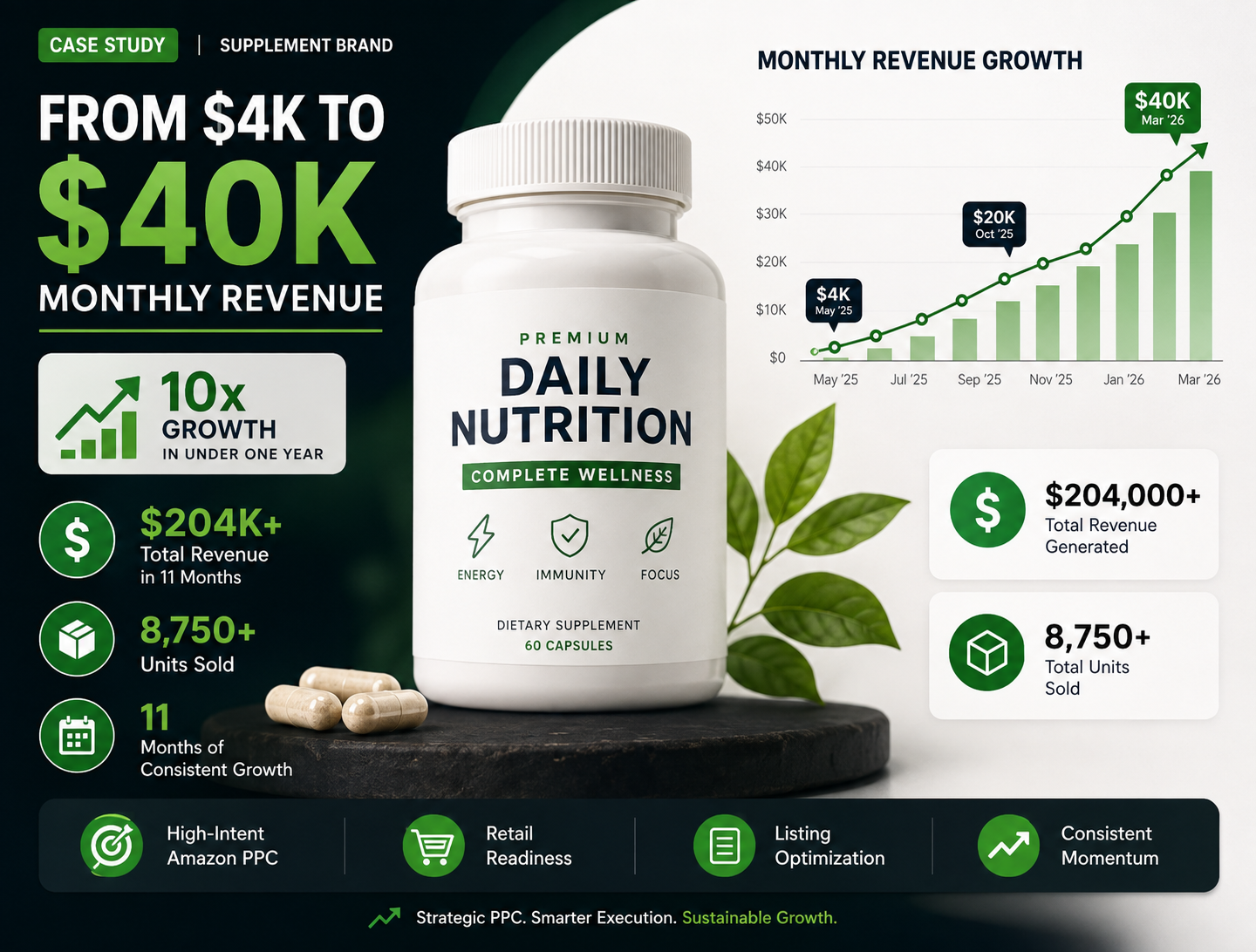
- $4K → $39.4K/month — nearly 10× growth in under a year.
See how our Amazon PPC strategy helped a supplement brand grow monthly sales from $4K to nearly $40K despite $6–$7 CPCs using keyword ranking, retail readiness, Creator Connections and external traffic.
From $4K to $40K/Month: Amazon PPC Case Study for a Supplement Brand
How a Ranking-Focused Amazon PPC Strategy Helped Scale Monthly Sales Nearly 10× in Under a Year
$22.99 Selling Price · $6–$7 Top-of-Search CPC · 10–15% Conversion Rate
Scaling an Amazon supplement brand in a highly competitive category requires more than increasing advertising budgets.
This brand faced $6–$7 Top-of-Search CPCs on high-intent keywords while selling its product for just $22.99. Even after optimizing the Amazon listing and achieving a 10–15% conversion rate, the economics left little room for inefficient advertising.
Yet across 11 months of performance, monthly revenue grew from approximately $4K to nearly $40K — 9.7× increase.
We didn't achieve that by simply spending more on Amazon PPC or forcing every campaign toward a lower ACOS.
Instead, we built an integrated Amazon supplement growth strategy around retail readiness, Amazon SEO and keyword rankings, disciplined PPC investment, creator partnerships, and external traffic.
The objective was clear:
Use Amazon advertising to create sales velocity and support organic growth while keeping TACOS within sustainable business-level benchmarks.
The Challenge: Scaling Amazon PPC With $6–$7 CPCs
When One Click Costs Nearly 30% of Your Product Price
The brand was competing in a saturated Amazon supplements category with a selling price of $22.99.
For strategically important, high-intent keywords, Amazon Top-of-Search CPCs regularly reached $6–$7.
That meant a single premium-placement click could cost approximately 26–30% of the product's selling price.
After completing our retail-readiness work, the Amazon listing was converting at approximately 10–15%.
At that observed conversion rate, approximately 7–10 clicks could be required to generate an order.
This created a difficult PPC trade-off.
Bid too aggressively, and customer acquisition costs could quickly become unsustainable.
Pull back too far, and the brand could lose the sales velocity and visibility needed to compete for valuable organic keyword positions.
So our Amazon PPC strategy wasn't built around achieving the lowest possible ACOS.
The real question was:
Where could additional PPC investment create long-term value for the Amazon business and where were we simply buying expensive traffic?
The Strategy: Connect Amazon PPC With Organic Growth
Our goal wasn't to maximize the percentage of sales coming from advertising.
We wanted Amazon PPC to help create enough targeted sales velocity that the brand could strengthen its visibility and compete for more organic Amazon sales over time.
That meant treating PPC as part of a broader Amazon growth system:
Retail Readiness → Competitive Pricing → Amazon PPC → Keyword Rankings → Organic Sales → Traffic Diversification
Here's how we approached it.
Amazon Retail Readiness Before Scaling Ad Spend
Before increasing Amazon advertising spend, we focused on improving what happened after shoppers clicked.
The product listing, positioning and creatives were optimized around the brand's ideal customer profile (ICP).
We refined the content to communicate the product's value more clearly and aligned the offer with what shoppers were seeing from competing supplement brands.
Pricing was also evaluated against the competitive landscape so the $22.99 price point represented strong value for money.
Trust was another critical conversion factor.
The brand invested in third-party product testing, adding another credibility signal for shoppers evaluating the supplement against established competitors.
The principle was simple:
Improve conversion before buying more traffic.
Following this retail-readiness work, the listing was converting at approximately 10–15%, providing a stronger foundation for Amazon PPC scaling.
Amazon PPC Built Around Organic Keyword Rankings
Instead of optimizing Amazon PPC campaigns only around immediate advertising metrics, we incorporated organic keyword ranking into our decision-making.
Strategically important search terms were mapped according to their existing organic positions and segmented into ranking tiers:
Organic Keyword Rank
PPC Objective
Positions 1–10
Defend high-value rankings
Positions 10–24
Push toward stronger Page 1 visibility
Positions 25–48
Build sales and ranking momentum
Page 2+
Invest selectively based on opportunity
This helped us determine where advertising spend had the greatest strategic value.
Rather than distributing PPC budgets evenly across hundreds of search terms, we prioritized high-intent keywords with realistic opportunities to move into stronger organic positions.
For example, a commercially important keyword sitting close to a valuable ranking threshold could justify more aggressive investment than a keyword buried much deeper in Amazon search results.
In other words:
Organic rank became an input into PPC optimization—not simply a metric we checked afterward.
Root-Keyword Campaign Segmentation
Our Amazon PPC campaign structure was also organized around strategically important root keywords and search themes.
Instead of treating every search term independently, we identified the broader keyword families where we wanted the product to build relevance and sales history.
The strategy was designed around a progression:
High-Intent Amazon PPC → Sales Velocity → Ranking Opportunity → More Organic Orders
This gave campaigns a purpose beyond simply generating another paid order.
We weren't trying to win every Amazon advertising auction.
We wanted to compete hardest for the search terms capable of creating the greatest long-term value.
Balancing Amazon ACOS, CPC and TACOS for Growth
With $6–$7 Top-of-Search CPCs, some high-intent Sponsored Products campaigns were naturally expensive.
Forcing every campaign toward the same low ACOS target could have meant cutting visibility on some of the exact keywords we were strategically trying to grow.
So we optimized for total business growth—not campaign-level ACOS in isolation.
When conversion performance, organic ranking opportunity and strategic importance justified the investment, certain campaigns could operate at a higher ACOS.
At the same time, we didn't allow higher CPCs to dictate the economics of the entire account.
We balanced more aggressive ranking campaigns with Sponsored Brands Video campaigns and lower-bid PPC campaigns designed to capture relevant traffic without constantly competing for the most expensive Top-of-Search placements.
The approach was:
Invest where the opportunity justified it. Protect efficiency everywhere else.
And throughout the process, TACOS remained a key business-level guardrail for evaluating whether advertising spend was contributing to sustainable overall growth.
Amazon Creator Connections and External Traffic
High Amazon CPCs also reinforced the need to diversify customer acquisition.
The brand shouldn't have to buy every incremental order through Sponsored Products.
Amazon Creator Connections
We utilized Amazon Creator Connections to work with relevant creators through a commission-based model.
Creator commissions were approximately 15–20%, allowing the brand to generate additional product discovery and attributed sales while tying acquisition costs more closely to actual purchases.
This created another growth channel alongside traditional Amazon PPC.
External Traffic + Amazon Brand Referral Bonus
We also drove qualified external traffic to the Amazon listing while utilizing the Amazon Brand Referral Bonus where applicable.
This supported additional customer acquisition and branded demand without requiring every shopper to originate from an increasingly expensive Amazon keyword auction.
Amazon PPC remained a core part of the growth strategy.
It simply wasn't expected to generate every incremental sale.
The Results: From $4K to Nearly $40K in Monthly Amazon Sales
The growth wasn't driven by one temporary spike.
Monthly Amazon revenue progressively increased throughout the period
The Growth Journey
The growth was progressive, not the result of one breakout month.
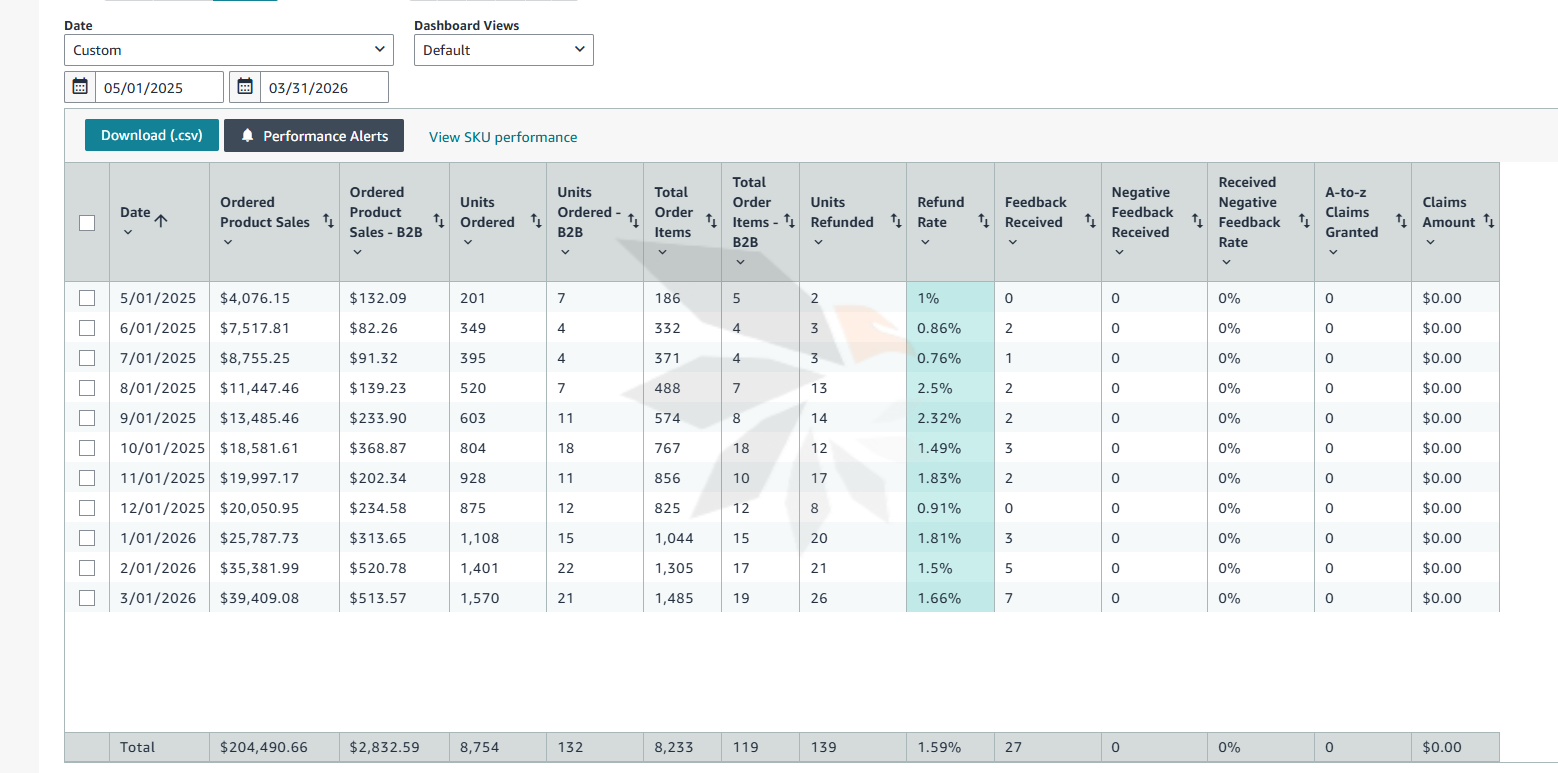
Monthly Amazon revenue moved from $4.1K in May → $8.8K in July → $13.5K in September → $20.1K in December → $25.8K in January → $35.4K in February → $39.4K in March.
That took the brand from roughly $4K to $39.4K/month — a 9.7× increase across 11 months of performance. During May 2025–March 2026, the brand generated $204K+ in Amazon revenue and sold 8,754 units.
But the growth wasn't driven by one PPC tactic. We built a connected system:
Retail Readiness → Stronger Conversion → Intentional PPC → Sales Velocity → Ranking Opportunities → Organic Growth
Amazon Creator Connections and external traffic added additional acquisition channels around that core engine.
What Made the Strategy Work
There was no secret campaign type or shortcut. The difference was giving every advertising dollar a specific role.
High-intent campaigns captured demand and supported priority keyword rankings. Lower-bid and Sponsored Brands Video campaigns helped balance expensive Top-of-Search traffic, while Creator Connections and external traffic reduced dependence on Sponsored Products alone.
Rather than judging performance through ACOS in isolation, we evaluated PPC alongside TACOS, conversion, keyword rankings, organic orders, and total business growth.
The Takeaway
With a $22.99 product and $6–$7 Top-of-Search CPCs, neither blindly increasing bids nor cutting spend to chase a lower ACOS was the answer.
The strategy was to know where to invest for growth, where to protect efficiency, and where PPC could support longer-term organic visibility.
By combining retail readiness → pricing → ranking-focused PPC → Creator Connections → external traffic, we built a more balanced Amazon growth engine.
$4K → $39.4K/Month
9.7× Monthly Revenue Growth
$204K+ Revenue | 8,754 Units
The goal wasn't simply to buy more sales. It was to build sustainable momentum beyond paid advertising.
Want a launch like this one?
One strategy call is all it takes to map out your next product opportunity.
Book a Strategy Call →