
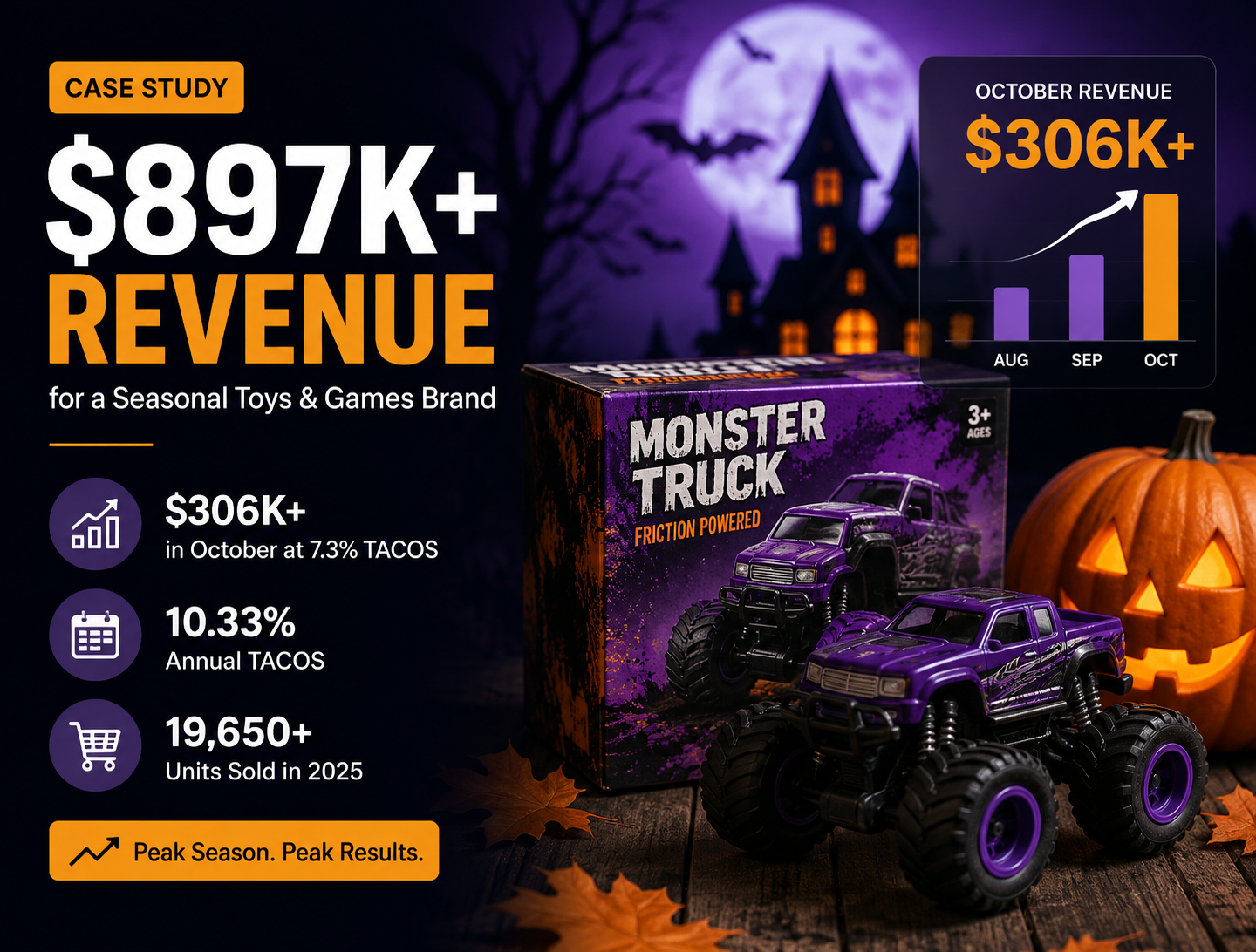
Seasonal Amazon PPC Case Study: $897K+ Revenue at 10.3% TACOS
- CHALLENGE
- Seasonal demand created a narrow window to capture Halloween & Q4 sales.
- STRATEGY
- Built momentum pre-season, then scaled PPC as demand and conversion peaked.
- OUTCOME
- Captured $306K+ in October while lowering TACOS to 7.3%.
How PeakHawks generated $897K+ in annual revenue for a seasonal Toys & Games brand by aligning Amazon PPC with Halloween and Q4 2025 demand—reaching $306K+ in October at 7.3% TACOS.
Seasonal Amazon PPC Case Study: $897K+ Revenue at 10.33% TACOS
How a Toys & Games Brand Generated $306K+ in October by Building Demand Before the Seasonal Peak
Seasonal Amazon brands don't have the luxury of getting Q4 wrong.
When a large percentage of your annual opportunity is concentrated around Halloween and the holiday season, every week matters.
Scale too early, and you can burn advertising budget before customers are ready to buy.
Scale too late, and competitors capture the demand you've spent the year waiting for.
This Toys & Games brand needed an Amazon PPC strategy built around that reality.
Instead of maintaining the same bids, budgets and ACOS targets throughout the year, we aligned advertising investment with seasonal demand, conversion behavior and profitability.
The result in 2025:
$897K+ Revenue · $438K+ Profit · 10.33% TACOS
And when Halloween demand peaked:
$306K+ Revenue in October at 7.30% TACOS
But the most important part of this case study isn't October.
It's what happened before October arrived.
The Challenge: How Do You Scale a Seasonal Amazon Brand Without Wasting Ad Spend?
Seasonal Amazon PPC creates a timing problem.
This brand sells Toys & Games products with significant Halloween and Q4 demand.
But customers don't buy at the same rate throughout the year.
Revenue illustrates the difference:
June: $16.8K → September: $94.2K → October: $306.5K
That's an 18× difference between June and October.
Running the same PPC strategy across both months wouldn't make sense.
The brand needed to solve three problems:
When should we start investing ahead of the season?
How aggressively should we scale when demand peaks?
How do we capture maximum revenue without sacrificing profitability?
Our answer was to stop treating every month equally.
The Strategy: Follow the Customer's Buying Cycle
We built the Amazon PPC strategy around one principle:
Advertising intensity should follow purchase intent.
When customers were months away from peak buying behavior, our priority was learning and positioning.
As seasonal searches increased, our priority shifted toward building visibility and sales velocity.
And when conversion peaked, our priority became capturing as much profitable demand as possible.
The strategy followed four phases:
Prepare → Build Momentum → Scale → Harvest
This allowed us to enter Q4 with data, established campaigns and a clear understanding of where additional advertising dollars could create the greatest return.
1. Prepare Before Everyone Starts Competing for Q4
The worst time to figure out your Amazon PPC strategy is when your biggest sales window has already started.
We used the months before peak season to strengthen the account.
That meant improving retail readiness, campaign structure, keyword coverage and conversion opportunities before aggressively increasing spend.
More importantly, we used this period to learn.
Which keywords were actually converting?
Which products responded best to paid traffic?
Which search intents showed the strongest purchasing behavior?
Which placements deserved more investment?
And where could PPC contribute to stronger organic visibility?
This created a foundation we could scale later.
Before we increased the budget, we increased our confidence in where the budget should go.
2. Start Building Momentum Before Demand Peaks
We didn't wait for Halloween week to start competing.
As customer demand began accelerating, advertising investment followed it.
By September, revenue had reached:
$94,235
with 12.66% TACOS.
This pre-peak period was critical.
Campaigns that had already demonstrated relevance could receive more investment, while weaker traffic didn't automatically receive additional budget simply because Q4 was approaching.
The objective was to enter October with:
better visibility, stronger sales velocity and campaigns already positioned to scale.
Then demand accelerated.
3. When Customers Were Ready to Buy, We Were Ready to Scale
October was the highest-value demand window of the year.
And the economics changed dramatically.
PPC conversion increased from approximately 5% during parts of the summer to:
12.19% in October
A click became significantly more valuable because customers were much more likely to purchase.
So instead of protecting budgets during the most important month of the year, we scaled the campaigns where the economics justified it.
October produced:
$306,453 in total revenue
$174,590 in PPC sales
$22,365 in PPC spend
12.81% ACOS
7.30% TACOS
This is an important distinction.
Revenue didn't simply increase because we spent more.
Advertising efficiency improved as the business scaled.
That's what a seasonal PPC strategy should aim for: having the account ready to capitalize when customer intent becomes strongest.
4. We Didn't Try to Keep ACOS Identical Every Month
Brand owners naturally want efficient Amazon advertising.
But for seasonal products, optimizing every month toward exactly the same ACOS can lead to poor decisions.
Consider the difference:
June ACOS: 44.82%
October ACOS: 12.81%
If we treated those months as identical environments, we'd miss what was actually happening.
Customer demand had changed.
Conversion had changed.
The value of visibility had changed.
And therefore, the amount we were willing to invest could change too.
Instead of asking:
“Is every campaign hitting our ACOS target?”
we asked:
“Is this advertising investment creating enough value for the business right now?”
That meant looking beyond campaign-level ACOS at TACOS, conversion, organic sales, seasonal demand and overall profitability.
Across the full year, that approach resulted in:
10.33% TACOS
5. PPC Wasn't Expected to Generate Every Sale
A healthy Amazon growth strategy shouldn't necessarily require paid advertising to generate every incremental order.
Across 2025, this brand sold:
19,650 total units
Of those:
9,862 were organic units
That's approximately 50% of all units sold.
Meanwhile, PPC generated $471.5K in attributed sales from approximately $92.8K in advertising spend.
This balance mattered.
PPC captured demand and supported visibility, while organic sales contributed substantially to the overall business.
The goal wasn't simply:
more PPC revenue.
It was:
use PPC to help maximize total Amazon revenue.
6. Scale What Earns the Right to Scale
Q4 doesn't mean every campaign deserves more budget.
As demand accelerated, we continued using our SNOW Framework to decide where advertising dollars should go.
Scale campaigns demonstrating strong performance and additional opportunity.
Negate traffic consistently showing poor relevance or economics.
Optimize campaigns with potential but identifiable constraints.
Watch newer opportunities until enough data exists to make a confident decision.
This became even more important during peak season.
When demand is at its highest, the opportunity cost of wasted spend increases.
Every dollar spent on irrelevant traffic is a dollar unavailable for a search where a customer may be ready to purchase today.
We didn't scale everything for Q4. We scaled what earned it.
7. Halloween Was the Peak, Not the End of Q4
October was the largest month of the year.
But customer demand didn't disappear on November 1.
It changed.
As Halloween demand declined, we adjusted advertising around the products and search behavior benefiting from the broader holiday shopping season.
December subsequently generated:
$184,620 in Revenue
including:
$103,734 PPC Sales
$19,313 PPC Spend
18.62% ACOS
10.46% TACOS
This is another reason seasonal PPC can't operate on autopilot.
The opportunity that exists in September isn't necessarily the same opportunity available in October or December.
Budgets should follow demand not simply remain elevated because it's Q4.
The Growth Journey: What Seasonality Actually Looks Like
This wasn't a perfectly smooth revenue chart.
And it wasn't supposed to be.
January — $27.3K
↓
March — $47.5K
↓
June — $16.8K
↓
September — $94.2K
↓
October — $306.5K
↓
November — $56.0K
↓
December — $184.6K
A traditional growth case study might try to make every month look bigger than the last.
For this business, that would miss the point.
Success wasn't making June look like October. Success was making sure October reached its potential.
The Results: $897K+ Revenue With 10.33% TACOS
Across 2025, the brand generated:
$897.9K — Amazon Revenue
$438.9K — Profit
19,650 — Units Sold
9,862 — Organic Units
$471.5K — PPC Sales
$92.8K — PPC Spend
19.67% — ACOS
10.33% — TACOS
And during the biggest seasonal opportunity:
$306K+ October Revenue at 7.30% TACOS
For a brand owner, that's the result that matters:
We didn't just capture the seasonal spike. We captured it efficiently.
Why Did This Seasonal Amazon PPC Strategy Work?
There wasn't a secret campaign type.
And there wasn't one bid adjustment responsible for $897K in revenue.
The advantage came from timing advertising around customer behavior.
We prepared before demand arrived.
We built momentum as search intent strengthened.
We increased investment when conversion justified it.
We used organic sales as part of the overall growth equation.
And when one seasonal opportunity ended, we reallocated toward the next.
The entire strategy can be summarized in five steps:
Prepare → Position → Accelerate → Capture → Reallocate
That's what turned seasonality from a constraint into an advantage.
What Should Seasonal Amazon Brands Learn From This?
If your brand depends heavily on Halloween, Christmas, gifting, Q4 or another seasonal event, waiting for sales to spike before changing your PPC strategy is usually too late.
Your biggest month is often won in the weeks and months before it.
The campaigns need data.
The listing needs to convert.
The right keywords need visibility.
Budgets need somewhere intelligent to go.
And when customer intent finally peaks, the account needs to be ready to absorb substantially more demand without losing control of profitability.
That's why seasonal Amazon PPC shouldn't be managed like evergreen advertising.
Your strategy should change when your customer changes.
For this Toys & Games brand, that approach produced:
$897K+ Revenue in 2025
$306K+ October Revenue · $438K+ Profit · 10.33% TACOS
We didn't try to eliminate seasonality. We built the advertising strategy to capitalize on it.
Want a launch like this one?
One strategy call is all it takes to map out your next product opportunity.
Book a Strategy Call →